

“Should we use SQL or NoSQL?”
A founder asked us this last month like it was a religious war. It is not. It is a practical question with a practical answer, and by the end of this post you will be able to answer it for your own project.
No jargon. No fence-sitting. Just the real differences, explained simply.
What is a SQL database?
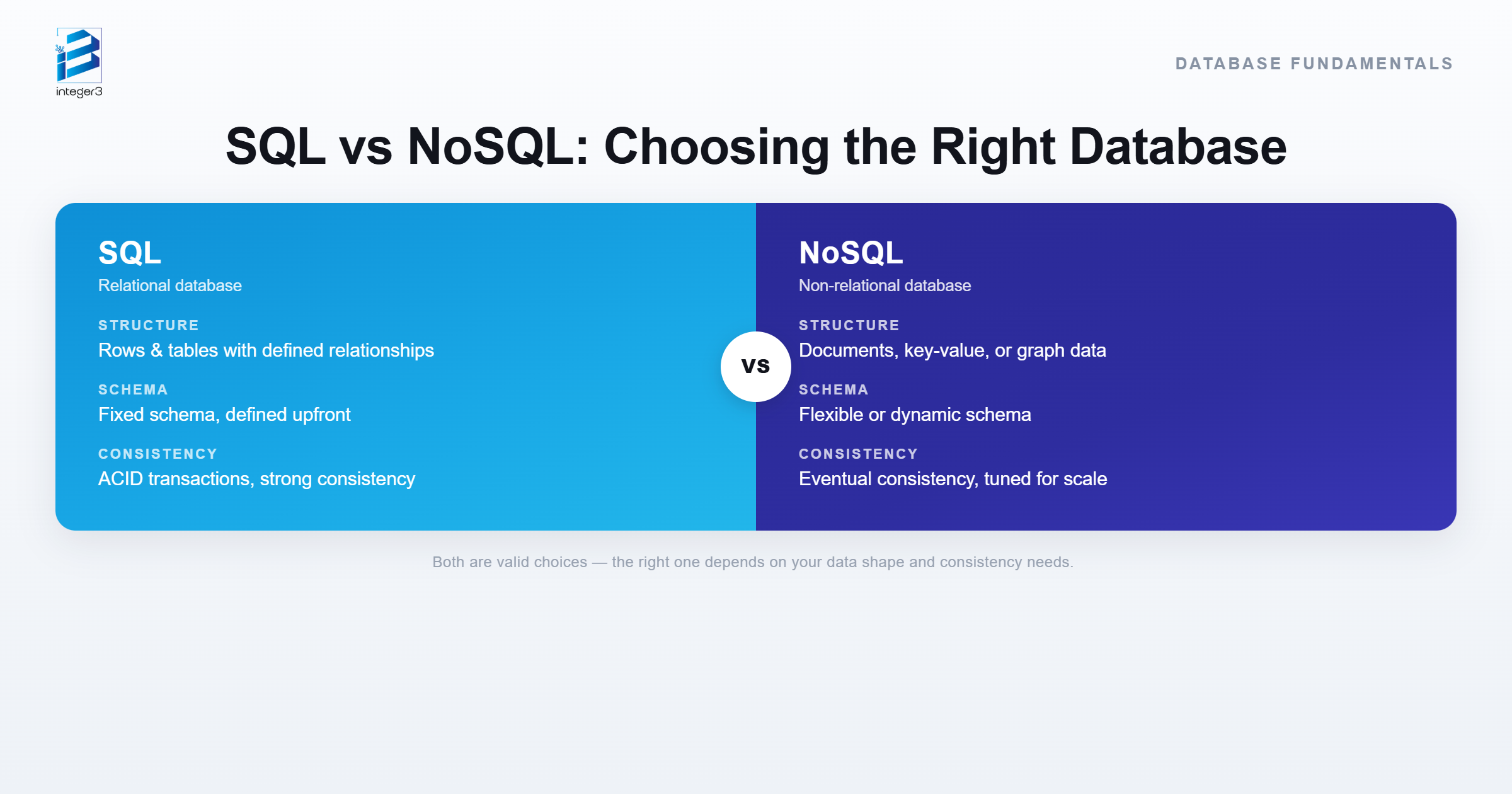
A SQL database stores data in tables, a bit like a very disciplined spreadsheet. Every row follows the same structure. A customer table has the same columns for every customer: name, email, phone, address.
These tables can also be connected to each other. Your orders table knows which row in the customers table it belongs to. That is why SQL databases are also called relational databases, because the relationships between data are built in.
Popular SQL databases include PostgreSQL, MySQL, and Microsoft SQL Server. They have been around for decades, and they run most of the world's banking, e-commerce, and business software.
What is a NoSQL database?
A NoSQL database is more relaxed about structure. Instead of strict tables, most of them store data as flexible documents, similar to a folder of JSON files. One customer record can have ten fields, the next one can have fifteen, and the database will not complain.
Popular NoSQL databases include MongoDB, Redis, and Amazon DynamoDB. They became popular when companies like Google and Amazon needed to handle enormous amounts of fast-changing data across many servers.
SQL vs NoSQL: the differences that actually matter
You will find long comparison tables online. In real projects, only four differences decide the choice.
1. Structure: strict vs flexible
SQL forces your data to follow a plan. That sounds limiting, but it is actually a safety net. Bad or incomplete data gets rejected at the door.
NoSQL lets every record be different. That is freedom when your data is unpredictable, and a mess when it is not. Flexible structure does not remove the need for structure, it just moves that job from the database into your code.
2. Consistency: perfectly right vs almost instantly right
SQL databases are built for transactions. When money moves between two accounts, either both steps happen or neither does. This is the famous ACID guarantee, and it is why banks and payment systems still run on SQL.
Many NoSQL databases relax this rule to gain speed. A change might take a moment to appear everywhere. For a social media like count, nobody cares. For an invoice, everybody cares.
3. Scaling: one strong server vs many small ones
SQL databases traditionally scale up: you buy a bigger server. Modern SQL can scale much further than people think, but it takes skill.
NoSQL databases were designed to scale out: you add more cheap servers and the data spreads across them automatically. If you genuinely expect millions of users, this matters. Most projects never get there, and that is fine.
4. Queries: asking hard questions of your data
SQL shines when you need answers that combine data from many places. “Show me every customer from Brisbane who ordered twice this year but not this month” is one short SQL query. In many NoSQL databases, that same question means extra work in your application code.
When to choose a SQL database
Choose SQL when your data is structured and connected, and being correct matters more than being fast at massive scale. In practice, that covers:
- E-commerce stores, orders, and inventory
- Anything involving payments, invoices, or accounting
- Booking and reservation systems
- Business dashboards and reporting
- Most web and mobile apps, honestly
When to choose a NoSQL database
Choose NoSQL when your data is messy or huge, and speed at scale matters more than perfect structure:
- Real-time chat and activity feeds
- Product catalogs where every item has different attributes
- Logging, analytics, and sensor (IoT) data
- Caching and session storage
- Apps that truly need to serve millions of users across regions
The answer most articles will not give you
If you are building a typical business application and you are not sure, choose SQL. PostgreSQL is free, battle-tested, and will comfortably handle more traffic than most businesses ever see.
The trendy choice and the right choice are not always the same thing. We have seen startups pick a NoSQL database because it sounded modern, then spend six months rebuilding once their reporting needs grew. Boring technology, chosen for the right reasons, ships products.
And it is not always either-or. Plenty of real systems use both: SQL for orders and customers, and something like Redis alongside it for caching and speed. The database is a tool, not an identity.
Quick FAQ
Is NoSQL faster than SQL?
For simple reads and writes at very large scale, often yes. For complex questions across related data, SQL is usually faster and far simpler. “Faster” always depends on what you are asking the database to do.
Is SQL outdated?
Not at all. SQL has been the backbone of software for over 40 years, and in the Stack Overflow Developer Survey, PostgreSQL and MySQL consistently rank among the most used databases in the world.
Can I switch databases later?
Yes, but it is painful, like changing the foundation of a house you already live in. That is exactly why it is worth an hour of honest thinking, or a short conversation with someone experienced, before you build.
Still not sure? Ask before you build
The wrong database will not hurt you in week one. It hurts you in month six, when the workarounds pile up and the rebuild quote lands on your desk.
At integer3, we help startups and businesses make these decisions before they get expensive, as part of our web and app development services. If you are planning a project and want a straight answer about your data setup, get in touch with us. Diagnosing first is kind of our thing.
Comments are closed